
Demystifying Strata & Community Levies: How They're Calculated and Used

Levies can feel like a mysterious and ever-increasing cost for many owners and residents in strata and community schemes. But behind every levy notice is a clear process, a legislated framework, and a practical purpose.
In this article, we'll unpack what levies are, how they’re calculated, what they’re used for, and how they connect to the financial health of your building. Whether you're a new apartment owner or just curious about where your money goes, this guide will break it down in plain English.
What Are Levies?
Levies are regular contributions made by lot owners to fund the operation, maintenance, and future needs of a scheme. These levies are paid into different administrative funds controlled by the owners corporation (or body corporate) / community association depending on the purpose.
There are generally three types of levies:
Administrative Fund Day-to-day running costs: cleaning, insurance, electricity, water, etc.
Capital Works Fund Long-term maintenance: painting, roofing, lift upgrades, etc.
Special Levies One-off or unexpected costs: emergency repairs, legal costs, shortfalls these can be paid into either fund as agreed in a meeting.
How Are Levies Calculated?
Levies are calculated based on two key factors:
The approved budget for the administrative and capital works funds.
Your unit entitlement, which reflects your share of ownership in the scheme.

Step-by-Step Calculation
Let’s break down the levy calculation in a typical scheme.
Step 1
The Annual Budget Is Set
At each annual general meeting (AGM), the owners corporation approves a budget for:
The administrative fund (day-to-day expenses)
The capital works fund (based on a 10-year plan or other expected works/costs)
These budgets determine how much needs to be raised for the upcoming financial year.
Example Administrative Fund Budget (Total: $35,000)
This covers regular day-to-day expenses of running the building
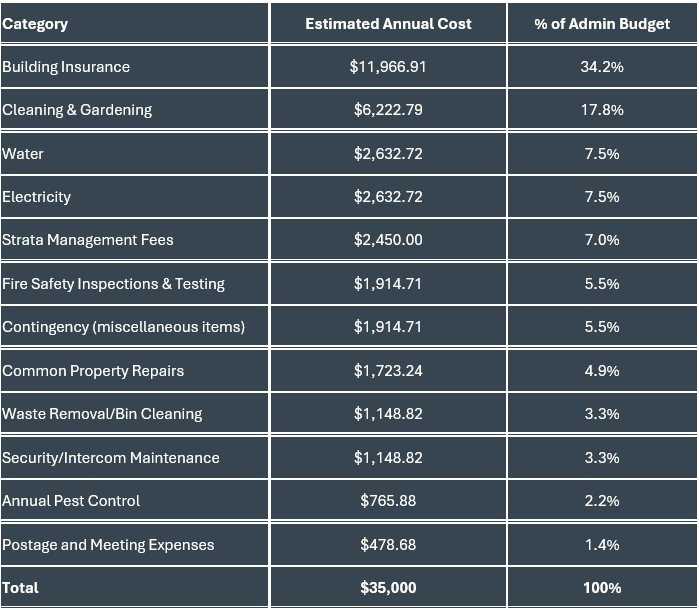
Example Capital Works Fund Budget (Total $15,000)
This covers long-term maintenance and upgrades

Total Combined Budget: $35,000 (Admin) + $15,000 (Capital Works) = $50,000
Step 2
Unit Entitlements Are Applied
Every lot has a unit entitlement (UE), which is usually listed on the strata/community plan. This UE number reflects the lot’s share of ownership (and voting power) in the scheme and determines how much of the total budget you must contribute.
Example Table: Levy Calculation
Imagine this strata scheme has 5 lots
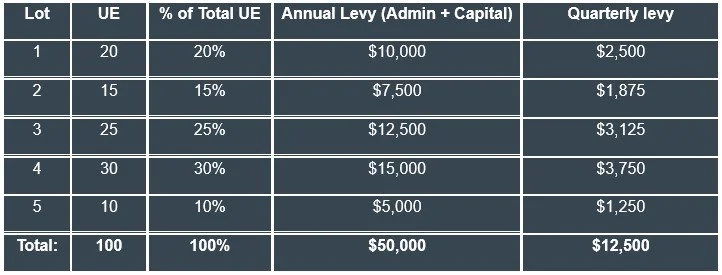
Levies are often paid quarterly, so in this example Lot 3 would pay $3,125 each quarter.
Owner Tip: Your unit entitlement is fixed at the time of registration of the scheme; it can only be altered by a court or Tribunal order. It’s not up to the strata committee or strata manager to change this, quite simply they can’t!
Understanding the Budget
Strata and community schemes are required to prepare budgets annually. These budgets must be “reasonable” and account for known and anticipated expenses.
How is the Capital Works Fund Forecasted?
Under NSW law for example (and similar in other states), the scheme must have a 10-year capital works plan. This plan helps forecast future large expenses and allows for steady contributions rather than sudden, costly special levies.
Avoiding Special Levies: A well-managed capital works fund helps avoid financial shocks like special levies — which can sometimes be thousands of dollars per lot.
Special Levies: Why and When They’re Raised
A special levy is an extra charge on top of regular levies. These are typically raised when:
Emergency works are needed (e.g., major plumbing failure)
Legal fees arise from disputes
The capital works fund is underfunded
An unexpected cost exceeds the existing budget
Special levies must be approved at a general meeting by an ordinary resolution.
How Are Levy Increases Decided?
Levy increases are tied to the budget estimates, not arbitrary decisions.
Increases may be needed due to:
Inflation and rising service costs
New services (e.g., upgrading security or cleaning schedules)
Catching up on underfunded capital works plans
All owners have a vote at general meetings where budgets are approved. It's vital to attend these meetings or at least review the agenda papers.
Owner Tip: If you’re unsure why levies have gone up, request a copy of the budget and the Minutes of the Meeting and ask for clarification from the strata manager or committee.
Who Prepares the Budget and Collects the Levies?
The strata manager (if appointed) usually prepares a draft budget in consultation with the committee otherwise it’s the appointed Treasurer.
The owners corporation must approve the levies at a general meeting (usually the Annual General Meeting - “AGM”)
Levies are typically collected quarterly, with notices issued ahead of time, the levy notices have the payment details.
Remember unpaid levies may attract interest and recovery fees.

What Happens If Levies Aren’t Paid?
Owners who fall behind on levy payments may face:
Interest of up to 10% per annum (in NSW)
Debt recovery action (legal fees may apply)
Restrictions on voting at meetings
Unpaid levies affect the financial stability of the scheme and can delay essential works.
How to Stay Informed and Involved
Read your AGM notices and budgets carefully.
Ask questions before or during meetings if something isn’t clear.
Join the strata committee if you want more say in how funds are allocated.
Review past and future capital works plans to understand the long-term health of your building.
Why Levies Matter
Levies aren’t just another bill, they’re your share in running and maintaining your home or investment.
A transparent, well-budgeted scheme benefits everyone by:
Keeping the building amd common property safe and functional
Maintaining property values
Reducing the risk of large, unexpected expenses
Disclaimer:
This article is intended for general educational purposes only and does not constitute legal or financial advice. Readers should seek independent legal and professional guidance relevant to their specific circumstances and jurisdiction.